Crash Consistency
Crash Consistency is an important property for systems with durable storage. It says:
After a crash, the application could recover to a consistent state from the persistent storage (e.g. durable disk, or non-volatile memory).
Also called crash-safety. It is clearly a form of safety property.
Crash consistency might be violated due to:
- Ordering : Missing fence or flush leading to undesired persistence order, corrupting the persistent data. This does not happen for a Strict Persistency setting, where persistence order follows visibility order.
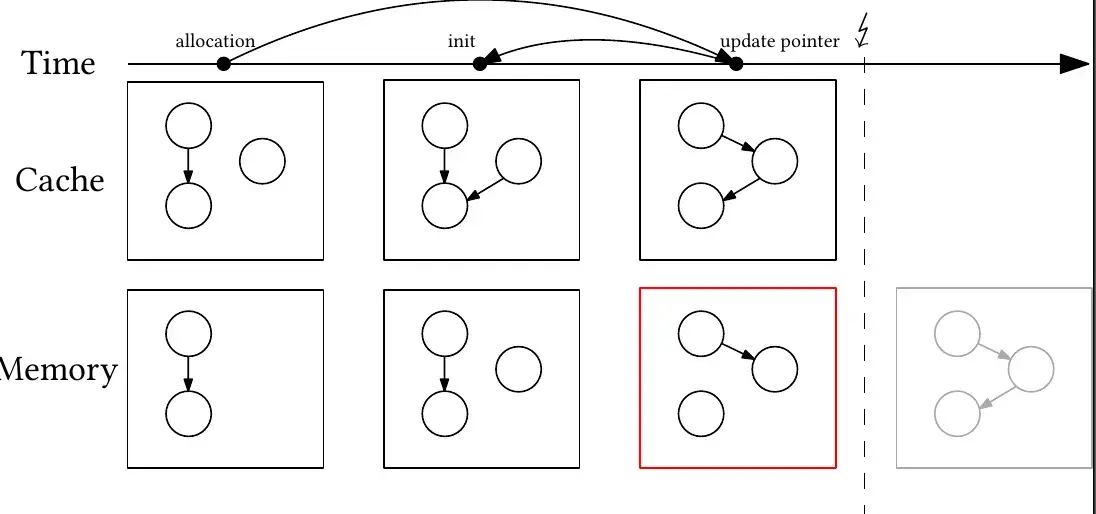
- Atomicity : If crash interrupts operations that ought to be atomic, data might be corrupted if not recovered correctly.
Obviously, crash consistency bug is possible whether the program is sequential or concurrent. Concurrency adds to the difficulty, esp. weak memory model.
Detecting Crash Consistency Bugs
Generally, determining crash consistency bugs requires ==application specific knowledge to understand what states are considered consistent.==
Criteria
- User Annotation. For example, PMTest and PMDebugger rely on programmers to explicitly annotate ordering constraints e.g.
x=1persists beforey=1. XFDetector requires ordering constraints are specified as well. - Automated Detection
- Utilize observable faults for bug detection. Jaaru, Witcher and various other tools use this method. They only detect ordering bugs when the program crashes or assertion fails. (The issue is that not all bugs cause such visible symptoms, i.e. some corruption is silent.)
- Robustness (PM) checking.
Robustness is a sufficient yet not necessary condition for Crash Consistency.Actually, robustness + memory consistency is. Robustness alone only tells behavioural equivalence to Strict Persistency
Existing methods
Testing
Dynamic Model Checking
- Jaaru
- Yasheme for persistency race/atomicity violation detection
Logics
- Crash Hoare Logic (for sequential file system)
- Perennial (for concurrent file system, no WMM behaviour)
- Spirea (for NVM)