Linearizability
In a concurrent system, an execution of the system results in a history, an ordered sequence of completed operations, which is composed of function invocations and responses. A sequential history is one in which all invocations have immediate responses.
A history is linearizable if there is a total order lin of completed operations such that
- Every operation has the same result if they were completed one by one in the order
lin. (All operations appear as atomic to the client) - If an operation
acompletes before another operationbbegins, thenaprecedesbinlin. (The order should obey the real-time execution)
A program (or object) is linearizable if all valid history of it can be linearized.
Proof
linearization point
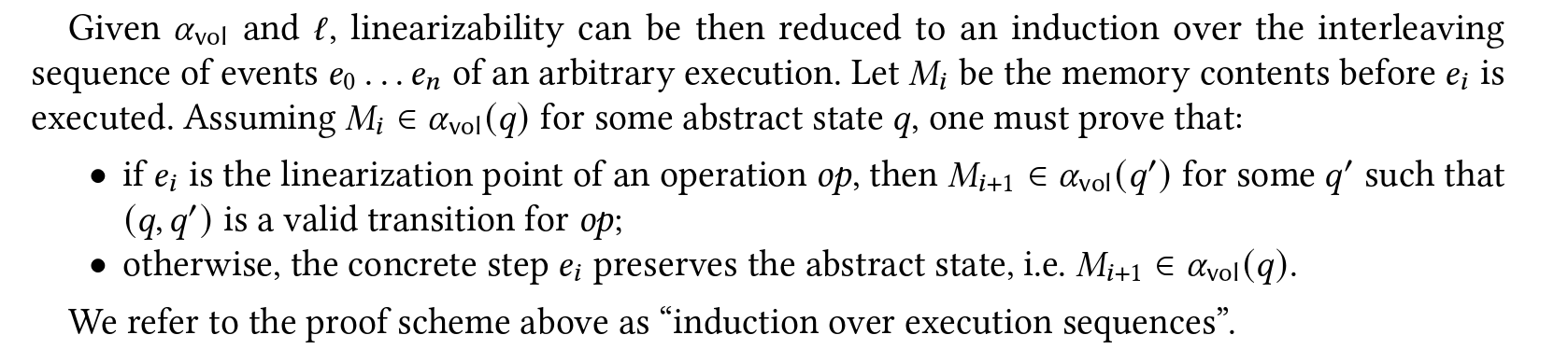
A common way to prove linearizability, under Sequential Consistency , is through identifying the linearization point of each function call, namely the concrete event (i.e. memory access) in the function implementation that represents the moment when the function’s effects become observable to other operations.
In this case, linearizability can be proved by an induction over the execution . See below: